
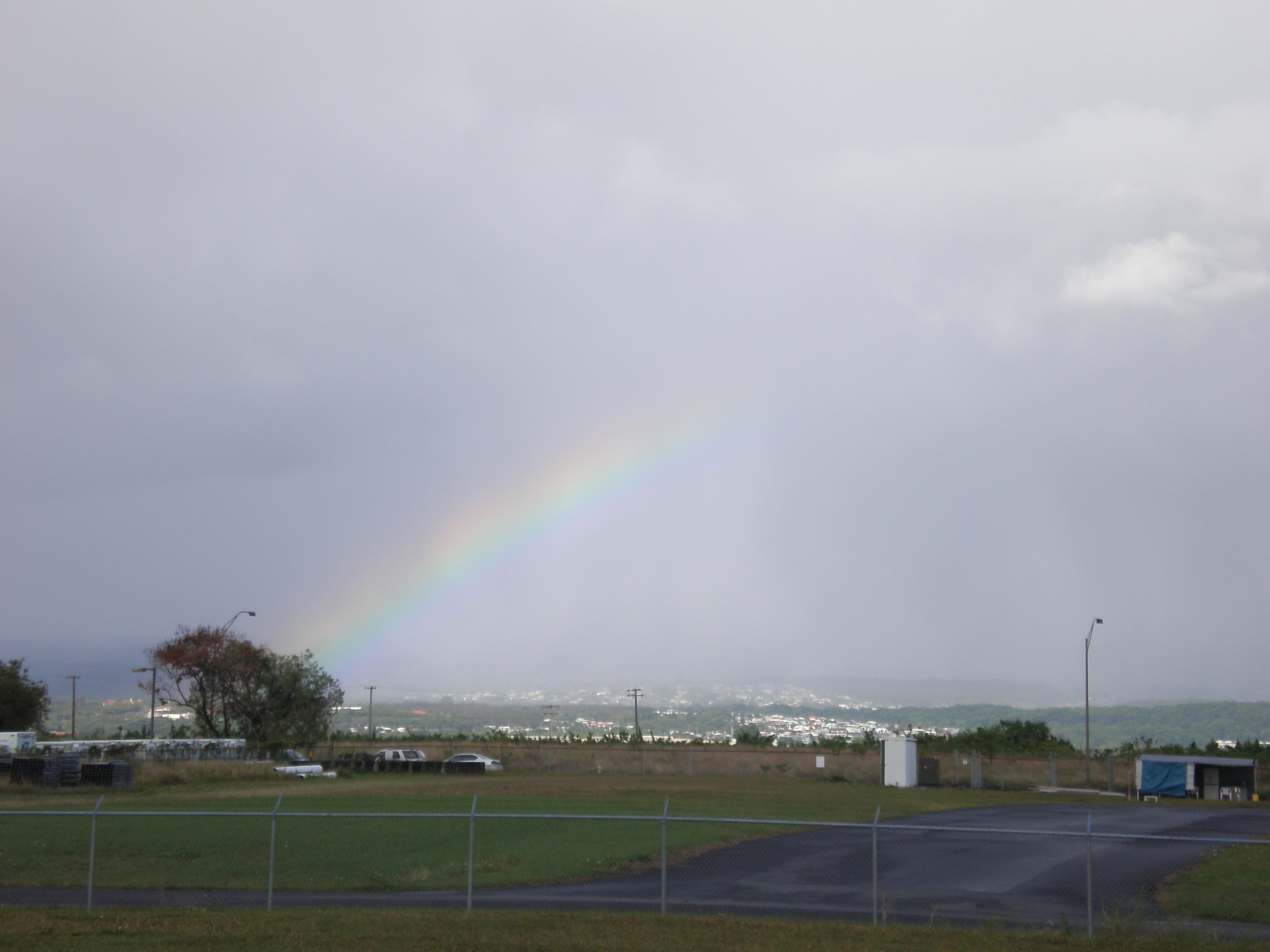
Last week I did a blog post about how drought manifests itself along the windward slopes of the Hawaiian Islands, with an emphasis on the record-breaking dry August conditions on the Big Island. To better establish the overall context of windward rainfall, I thought it would be useful to cover the annual rainfall cycle for these areas. This is also a matter of completeness, since a few weeks ago I did a post on the annual rainfall cycle on the leeward slopes, and the exception found on the Kona slopes of the Big Island. I would be remiss if I failed to cover the same thing for the windward slopes, especially since these areas receive the most rainfall in the state.
Before I get into the data, I should also define what I’m referring to as “windward” versus “leeward”. Local people may say, “why you gotta explain dat?”, but as my friend Tom reminded me, “you’re on the World Wide Web” so I shouldn’t assume every reader understands the concept as it is used in Hawaiʻi. In meteorological terms, windward is the side facing the wind, and leeward is the side facing the opposite direction, or downwind. Because the trade winds blow around 70 percent of the year in Hawaiʻi, windward is assumed by locals to be on the northeast- or east-facing sides of the islands. It is so ingrained into the local culture that institutions and businesses incorporate windward and leeward into their names. Thus, if you’re in Honolulu during a period when we have southwest winds, saying you’re on the windward side may be correct meteorologically, but it will result in you losing your kamaʻāina discount. If you don’t know what kamaʻāina means, you also forfeit your kamaʻāina discount. Anyway…on to windward rainfall!
The map below includes sites that I’ll be using in the rainfall discussion that follows. Hilo Airport, West Wailuaiki Stream, Waiheʻe Pump, and Wailua UH Experiment Station are good representative windward locations. Mānā, in west Kauaʻi, is included as the leeward representative for comparison purposes. Mānoa Lyon Arboretum is technically on the leeward side of Oʻahu’s Koʻolau Range, but its annual rainfall cycle behaves like a windward location for reasons that I’ll explain later. Lastly, Kauaʻi’s Waiʻaleʻale, one of the wettest spots in the state, is also worth covering. It’s at the top of Kauaʻi’s windward side but has its own quirks that are interesting.

Map of rain gage locations used in the discussion.
Taking a look at average monthly rainfall from windward locations will usually show a multi-modal annual cycle with three peaks. The distinctiveness of the peaks may vary from place to place, but you will usually find three. The first is in March, and at some locations represents the wettest month of the year, such as at West Wailuaiki Stream on Maui. The driest month of the year usually occurs in May or June, followed by the second peak in July or August. The third peak, which is the wettest month of the year at some windward locations, occurs in November. Hilo Airport is interesting in that its summer maximum used to be in July, but shifted to August in the 1991-2020 climatology release. The 49.18 inches recorded in August 2018, of which 36.76 inches occurred during the 4-day period when Hurricane Lane passed south of the Big Island, likely played a significant role in the shift.

Graph of average monthly rainfall in inches at the U.S. Geological Survey’s (USGS) rain gage at West Wailuaiki Stream. The average values are from the Rainfall Atlas of Hawaiʻi.

Same as above, except for the rain gage at the Wailua UH Experiment Station.

Same as above, except for the rain gage at Waiheʻe Pump.

Same as above, except for Hilo Airport. Average values used at this site are from the National Centers for Environmental Information (NCEI), 1991-2020 series.
Why these three peaks? That’s a really good question! I don’t recall seeing any comprehensive documentation explaining it, though admittedly, I haven’t done an exhaustive literature review either. I can only offer my hypotheses based on looking at Hawaiʻi rainfall for over 30 years. The March peak is interesting because it’s toward the end of the October through April wet season. However, strong storm systems are still able to affect the Hawaiian Islands during this time of the year. Temperatures in the mid-levels of the troposphere are at their coolest, which provides the instability to support heavy rainfall. These factors contribute to March having the highest frequency of flash flood events in the Hawaiian Islands. Additionally, the trade winds are starting to return in force, which helps focus rainfall along the windward slopes. May is the start of the dry season for places in the state not on the Kona slopes of the Big Island. However, the windward slopes experience another uptick in rainfall in either July or August. Some of the increase is probably due to the increase in low level moisture due to the seasonal rise in sea surface temperatures. Another big contributor, though, is the increase in tropical cyclone activity, which I also covered in my August 1 post. Direct tropical cyclone impacts over the state don’t happen too often, but you don’t need a direct impact to produce a lot of rain. A close pass of a tropical cyclone, especially to the south of the island chain (like Hurricane Lane in August 2018), can produce tremendous amounts of rain. Even the remnants of a tropical cyclone can produce significant increases in rainfall as the leftover moisture and embedded showers ride the trade winds onto the windward slopes of the state. Lastly, the November peak is somewhat similar to the March peak. At some windward locations, it is the wettest month of the year. Like March, November can have some very strong storm systems affecting the state. The difference, though, is that instability producing the heavy rainfall is produced more by the higher low level moisture content since the sea surface temperatures are still rather warm at this time of the year. This can help offset the lack of really cool mid-tropospheric temperatures. On a related note, for a long time November had the highest flash flood frequency in the state, until it was surpassed by March several years ago.
For comparison purposes, I’ve included the monthly average rainfall for Mānā, in west Kauaʻi. This is a good representative site for the annual cycle of leeward rainfall in Hawaiʻi. Unlike the windward sites, Mānā has a very distinct wet season and dry season. The sharp increase in October lines up well with the start of the October through April wet season and the arrival of the season’s first cold front to the main Hawaiian Islands.

Same as the above graphs, except for Mānā, Kauaʻi. The monthly average rainfall values for this graph comes from the Rainfall Atlas of Hawaiʻi.
There are always exceptions, so I thought it would be useful to highlight one. The Mānoa Lyon Arboretum rain gage is technically on the leeward side of the Koʻolau Range on Oʻahu. The Koʻolau Range is not very tall, with its highest point at Puʻu Kōnāhuanui reaching just above 3100 feet. As a result, showers embedded within the trades, or those that develop along the windward slopes, can easily make it over the crestline of the range and dump its rainfall onto the leeward side. The graph below shows that the monthly rainfall at Lyon Arboretum behaves just like a windward site, having peaks in March, July, and November, even though it’s on the leeward slopes of the Koʻolau Range.

Same as the above graphs, except for the Mānoa Lyon Arboretum gage. Monthly average values used at this site are from the NCEI, 1991-2020 series.
The last site I wanted to highlight is Waiʻaleʻale on Kauaʻi. It is one of the wettest spots in the state, and its location near the center of the island allows it to catch rainfall from systems reaching the island from any direction. That said, its average monthly rainfall looks very much like a windward location with three peaks during the year (March, July, and November). In a future post (don’t know when), I would like to focus on Waiʻaleʻale’s rainfall and the long term trends at that well-known location.

Same as the above graphs, except for Waiʻaleʻale. The monthly average rainfall values for this graph comes from the Rainfall Atlas of Hawaiʻi.
To close out, I would like to mention that we’re fast approaching the October through April wet season. Because of this, the next several blog posts will focus on flash flooding and the wet season.